
FRP composite construction
The tanks provide structural strength and corrosion resistance for seawater environments and long-term water use.
FRP tank structures configured around site layout and live seafood holding requirements.

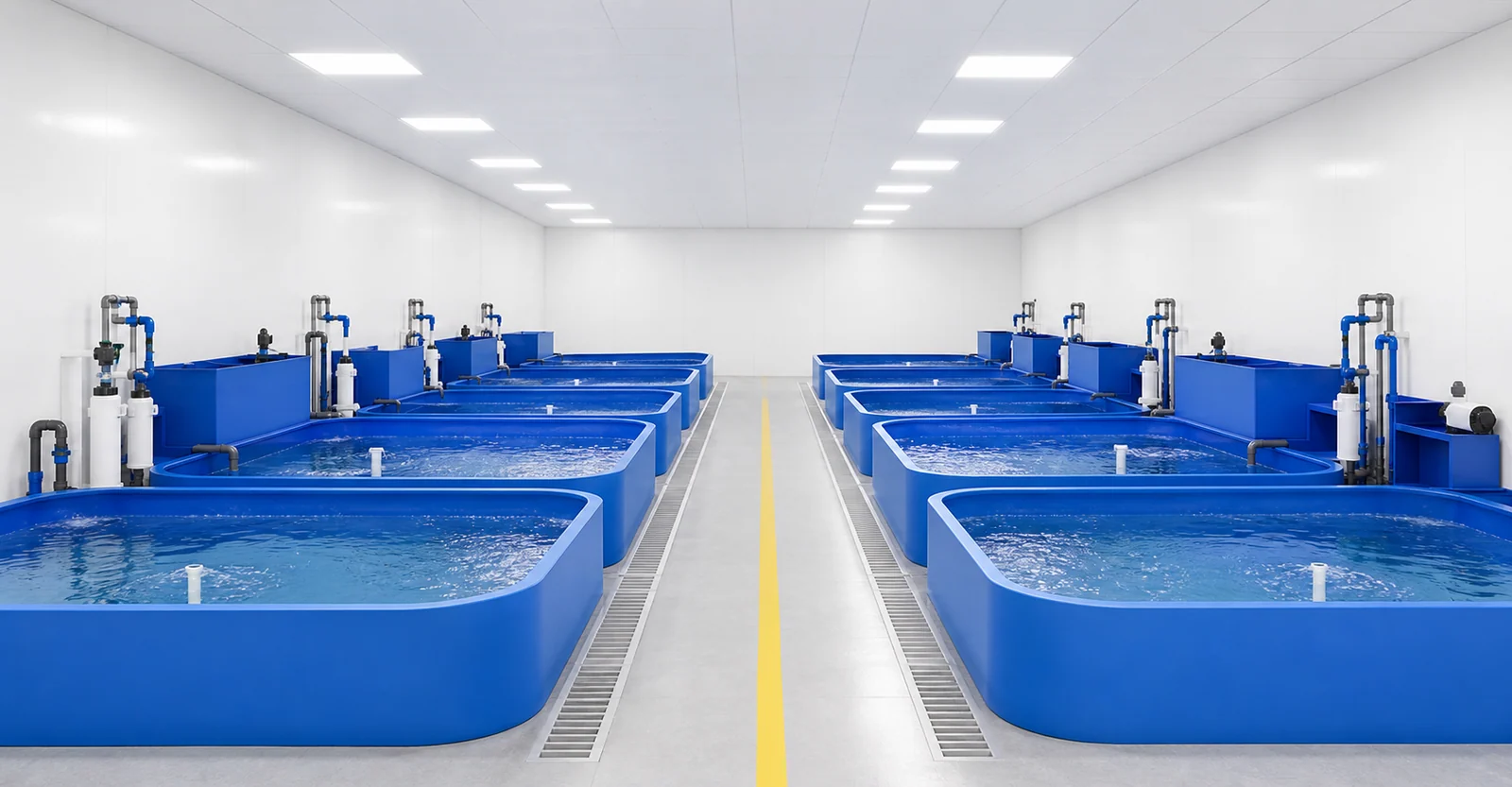
Modular FRP aquatic holding tanks are designed for live-seafood holding, storage, distribution and land-based recirculating aquaculture. The FRP construction and modular structure can be combined around the species, water volume, site dimensions and operating workflow, including projects for king crab, lobster, fish and shellfish.
The tanks can also be planned with circulation, filtration, aeration, cooling, sterilization and water-quality monitoring equipment. This makes them a practical system base for large seafood markets, live-seafood storage facilities, logistics transfer centres and aquaculture sites.
The tanks provide structural strength and corrosion resistance for seawater environments and long-term water use.
Tank sections can be separated, combined and moved to support site planning, packing, transport, on-site installation and later expansion.
Multiple tanks can be arranged side by side to meet the capacity and layout requirements of markets, storage, distribution and aquaculture projects.
Insulation or composite sandwich construction can be configured for low-temperature holding and local climate conditions to reduce environmental temperature influence.
Tank dimensions, shapes, connections and configurations can be made around the project and operating method.
The tanks can connect to recirculating pipework and be supplied with filtration, pumps, aeration, cooling, sterilization and monitoring equipment.
The tanks are divided and combined around capacity, internal sections and transport conditions to form the holding area.
Inlets, returns, overflows, drainage and aeration connections are planned together.
Circulation, filtration, sterilization and aeration equipment are selected around water volume and species.
Low-temperature projects can include cooling, insulation and water-quality monitoring equipment.
Footprint, water depth, capacity, shape and number of tank combinations.
Independent sections, dividers, observation areas and operating aisles.
Positions for inlets, returns, overflows, drainage and aeration.
Insulation construction matched to low-temperature species, local conditions and energy objectives.
The required scope of filtration, aeration, cooling, sterilization, pumps and water-quality monitoring.
Module division, container packing, on-site assembly and installation conditions.
Explore the product through photos of its structures, configurations and applications.
Share the species, capacity, site and operating conditions, and we will help define the tank combination and supporting water-treatment scope.
Need drawing-based production or private-label supply? Explore OEM & ODM services →